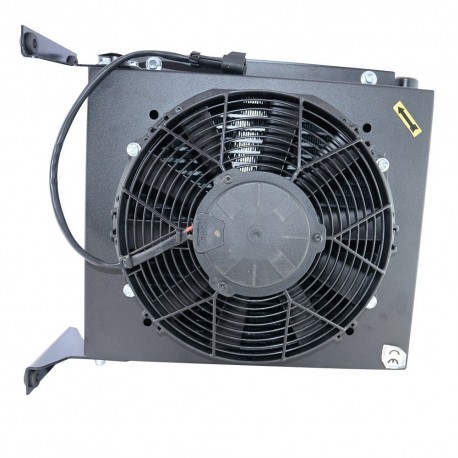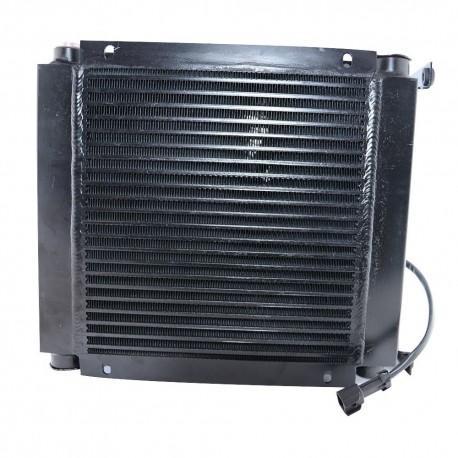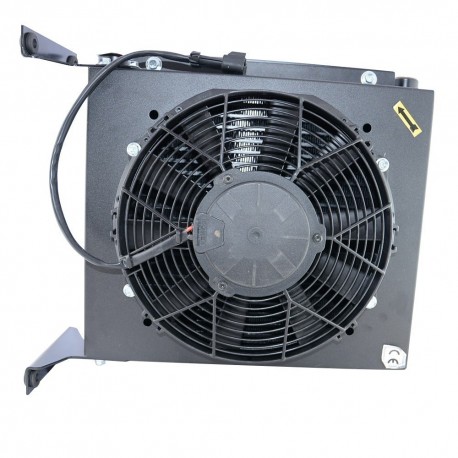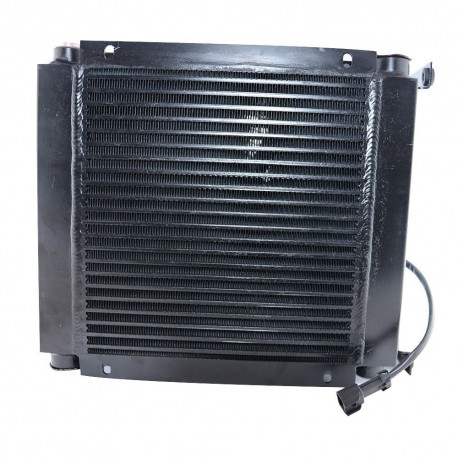
Oil Cooler
Browse our hydraulic oil coolers available online
A hydraulic oil cooler keeps the oil temperature under control in a hydraulic circuit. When oil becomes too hot, viscosity drops, internal leakage increases, seals wear faster and key components lose efficiency: hydraulic pumps, hydraulic motors, valves, distributors and cylinders.
OCGF supplies a wide range of hydraulic oil coolers, air/oil heat exchangers, tubular heat exchangers, brazed plate heat exchangers, cooling cores, fan motors and accessories for hydraulic systems. Our range covers mobile machinery, hydraulic power units, industrial equipment, agricultural machines, construction equipment and marine applications.
Depending on the reference, our hydraulic oil coolers are available in 12 V, 24 V, 230 V or 400 V versions. They help adapt the cooling system to your oil flow, oil temperature, working environment and installation type. OCGF helps you choose the right hydraulic heat exchanger, with available stock, secure payment and fast delivery in France and worldwide.
Hydraulic oil cooler: a key component for protecting your hydraulic circuit
In a hydraulic system, heat is never a minor issue. It is generated whenever oil is working: pressure drops in hoses, flow restrictions through valves, internal losses in a hydraulic pump, load cycles on cylinders and continuous operation of hydraulic motors. Over time, this heat builds up in the tank and changes the way the oil behaves.
A hydraulic oil cooler removes this heat before it affects the machine. Its purpose is to keep the oil within a stable temperature range, protect viscosity, reduce component wear and maintain consistent hydraulic performance.
When oil gets too hot, it becomes thinner. Internal leakage increases, the pump may become noisier, movements become less precise and seals are exposed to harsher operating conditions. On an industrial hydraulic power unit, log splitter, hedge mower, tractor, mini excavator or production machine, poor cooling can quickly lead to repeated failures.
Air/oil hydraulic cooler: the most common solution
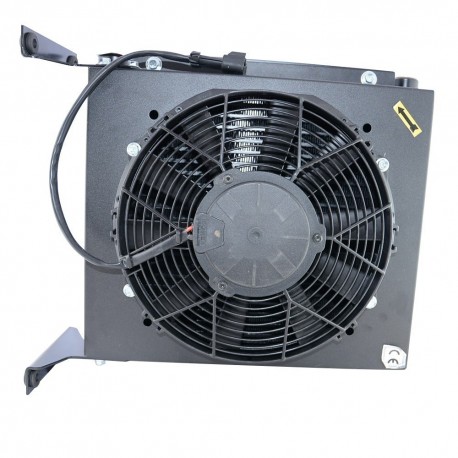
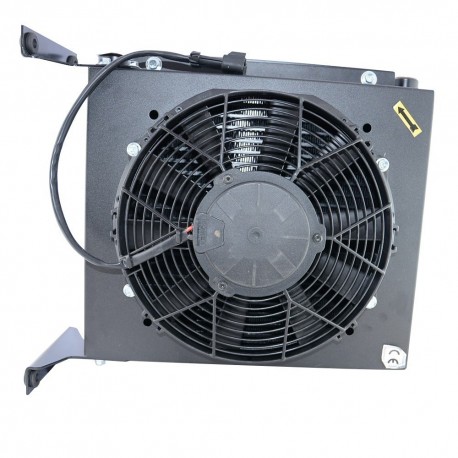
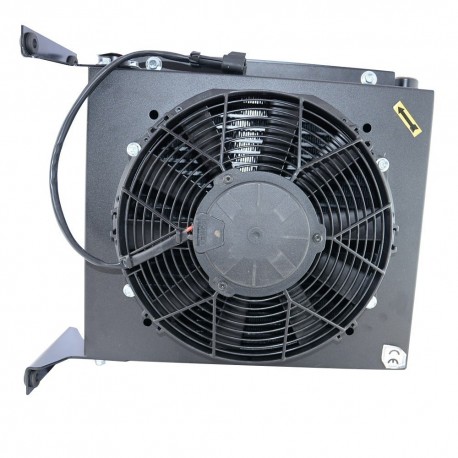
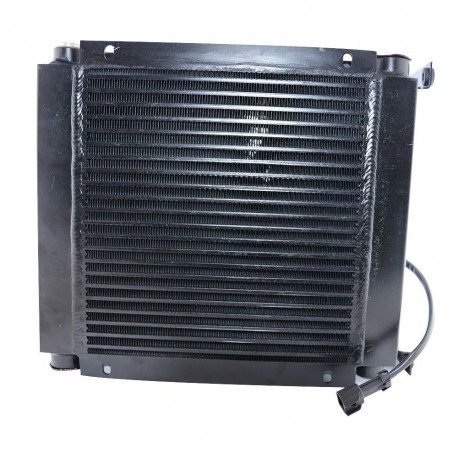
The air/oil hydraulic cooler is the most common cooling solution for mobile and industrial hydraulic systems. Oil flows through a cooling core while a fan forces air through the exchanger. Heat is transferred from the oil to the surrounding air.
This type of hydraulic heat exchanger is popular because it is self-contained, compact, easy to install and suitable for many machines. 12 V and 24 V versions are mainly used on mobile equipment: tractors, tipping trailers, log splitters, hedge mowers, mini excavators, forestry machines, aerial platforms and agricultural attachments. 230 V and 400 V versions are more suitable for stationary hydraulic power units, test benches, presses, industrial machines and workshop hydraulic units.
OCGF offers different solutions for replacement, new installation, return-line cooling, agricultural equipment and industrial maintenance.
CSL and CSLV hydraulic heat exchangers: designed for hydraulic oil circuits
CSL-type coolers are air/oil heat exchangers designed to cool hydraulic oil. They are available in several sizes, voltages and configurations depending on oil flow, available space and heat dissipation requirements.
CSLV versions include an important feature: an integrated thermostatic bypass. At cold start, hydraulic oil is more viscous. If it flows directly through the heat exchanger core, pressure drop may become too high. The bypass allows oil to avoid the core temporarily until the temperature reaches a suitable level. Once the oil is warm enough, it flows normally through the exchanger.
This is particularly useful for machines working outdoors, especially in agriculture, construction, forestry or material handling. A machine started in winter with cold oil does not behave like a machine already warm after two hours of work. This is where a heat exchanger with bypass can make a real difference.
12 V, 24 V, 230 V or 400 V hydraulic oil cooler: which one should you choose?
The voltage mainly depends on the machine type.
A 12 V hydraulic oil cooler is generally used on small mobile equipment, tipping trailers, log splitters or battery-powered applications.
A 24 V hydraulic oil cooler is common on agricultural machinery, construction equipment, heavier mobile machines and industrial vehicles. It is a robust option for machines working outdoors and sometimes continuously.
A 230 V hydraulic oil cooler is suitable for small workshop hydraulic power units, fixed machines, test benches or installations where single-phase power is available.
A 400 V hydraulic oil cooler is intended for industrial hydraulic power units, presses, production lines and machines with three-phase power. It is often the right choice when the system must handle longer cycles or higher heat loads.
Air/oil, tubular or plate heat exchanger: choose according to the application
Not all hydraulic heat exchangers are used for the same purpose.
The air/oil heat exchanger is the most common. It uses ambient air and a fan to cool the oil. It is suitable for mobile machines, hydraulic power units, agricultural equipment, construction machinery and standard industrial systems.
A tubular hydraulic heat exchanger transfers heat between oil and another fluid, usually water. It is suitable for industrial installations, onboard hydraulic systems, marine applications and environments where a cooling water circuit is already available.
A brazed plate heat exchanger is useful when space is limited and efficient heat transfer is needed in a compact format. It can be used on special machines, industrial hydraulic units, test benches or auxiliary circuits.
The correct choice depends on flow rate, temperature, heat load, available space, available cooling fluid and operating conditions.
How to size a hydraulic oil cooler
Sizing should not be guessed. A cooler that is too small will not remove enough heat. A poorly selected heat exchanger can create excessive pressure drop. A model without bypass may create issues at cold start. And a badly positioned cooler can lose much of its efficiency.
The main criteria to check are:
- oil flow rate in litres per minute;
- oil inlet temperature;
- ambient temperature around the machine;
- heat power to be dissipated;
- oil viscosity;
- allowable pressure in the exchanger;
- available voltage: 12 V, 24 V, 230 V or 400 V;
- fan type;
- air flow direction;
- thermostat requirement;
- need for thermostatic bypass.
The working environment also matters. An agricultural machine working in dust, a hedge mower exposed to plant debris or a construction machine working in mud does not have the same constraints as a hydraulic power unit installed in a clean workshop.
Where should a hydraulic oil cooler be installed?
In most cases, a hydraulic oil cooler is installed on the return line before the tank. This cools the oil after it has passed through the circuit while limiting pressure stress on the exchanger.
A few basic rules must be respected: leave enough free air flow, avoid placing the exchanger too close to a wall, reduce vibrations, protect the cooling core from impacts and make sure the return pressure remains compatible with the product specifications.
On some circuits, especially where the main oil flow varies heavily, an independent cooling circuit with a recirculation pump may be a cleaner solution. This allows better control of the flow through the exchanger and more stable cooling.
Typical applications for hydraulic oil coolers
| Application | Usually suitable solution | Why |
|---|---|---|
| Industrial hydraulic power unit | 230 V or 400 V air/oil cooler | Long cycles, mains power, stable oil temperature |
| Agricultural tractor | 12 V or 24 V hydraulic oil cooler | Mobile installation, battery supply, outdoor use |
| Log splitter | Compact oil cooler with fan | Repeated cycles and fast oil temperature rise |
| Hedge mower | Agricultural hydraulic oil cooler | Continuous operation and high oil stress |
| Mini excavator / construction machine | Robust air/oil heat exchanger | Load variations, dust, frequent cycles |
| Forestry machine | Mobile hydraulic oil cooler | Heavy-duty work, dust and debris |
| Marine installation | Tubular oil/water heat exchanger | Possibility to use a water circuit for heat removal |
| Compact machine | Brazed plate heat exchanger | Efficient cooling in limited space |
| Industrial maintenance | Fan motor, cooling core or complete exchanger | Targeted replacement depending on the failure |
Signs of a faulty hydraulic oil cooler
A faulty cooler does not always cause an immediate breakdown. Most of the time, the machine simply starts heating faster than usual. Then movements become less consistent, the pump becomes noisier, the oil loses stability and seals may wear faster.
Common signs include:
- oil temperature too high;
- fan not starting;
- faulty thermostat;
- clogged cooling core;
- damaged or blocked fins;
- oil leak;
- loss of performance when hot;
- machine slowing down after several cycles;
- abnormal back pressure on the return line;
- oil ageing too quickly.
On agricultural, construction or forestry machines, simple external clogging can strongly reduce cooling performance. In that case, the exchanger may not be undersized; it may simply no longer receive enough air flow.
Preventive maintenance for a hydraulic heat exchanger
Maintenance should be simple but regular. Clean the air side of the exchanger, check that the fan runs properly, test the thermostat, inspect fittings and make sure nothing blocks air flow.
On an air/oil heat exchanger, dust, straw, mud, leaves or chips can quickly reduce efficiency. On a tubular or plate heat exchanger, internal fouling and fluid quality must also be monitored.
Good maintenance helps avoid replacing a hydraulic pump or valve unnecessarily when the real issue is simply excessive oil temperature or poor cooling.
Why buy your hydraulic oil cooler from OCGF?
OCGF supplies a wide range of hydraulic oil coolers and heat exchangers for professional applications: industrial maintenance, agriculture, construction machinery, mobile equipment, hydraulic power units, marine systems and special machines.
Our catalogue includes air/oil heat exchangers, tubular heat exchangers, brazed plate heat exchangers, cooling cores, fan motors and accessories. Depending on the reference, you can select 12 V, 24 V, 230 V or 400 V versions, with or without thermostat, according to your hydraulic circuit.
OCGF also provides technical support. The goal is not just to sell a heat exchanger, but to help you choose a solution that matches your oil flow, working temperature, environment and installation. A properly selected cooler helps protect hydraulic pumps, hydraulic motors, hydraulic valves and the whole circuit.
To complete your hydraulic installation, also check your hydraulic pump, hydraulic motors and hydraulic valves. Temperature issues can come from cooling, but also from internal efficiency loss, a valve setting problem or leakage in the circuit.
FAQ – Hydraulic oil cooler
What is the main role of a hydraulic oil cooler?
The main role of a hydraulic oil cooler is to remove heat generated by the hydraulic circuit. It keeps the oil within a proper temperature range, preserves viscosity and protects the pump, hydraulic motors, valves, distributors and cylinders.
How do I choose the right power for a hydraulic oil cooler?
You need to know the oil flow, inlet temperature, ambient temperature, heat load to dissipate, oil viscosity and allowable pressure. The choice should not be based only on the maximum flow rate.
What is the difference between a hydraulic oil cooler and a hydraulic heat exchanger?
The term cooler refers to the function: cooling the oil. The term heat exchanger refers to the principle: transferring heat to air or another fluid. In hydraulic systems, both terms can refer to the same need, but the technologies may differ: air/oil, tubular or plate.
Where can I buy a hydraulic oil cooler for industrial machinery?
OCGF supplies hydraulic oil coolers for industrial machines, hydraulic power units, presses, test benches, agricultural machinery and mobile equipment, with technical support, available stock and fast delivery.
Which hydraulic oil cooler should I choose for agricultural machinery?
For agricultural machinery, 12 V or 24 V hydraulic oil coolers are often used depending on the available electrical supply. Oil flow, dust exposure, working temperature, available space and cleaning access must also be considered.
What are the signs of a faulty hydraulic oil cooler?
Common signs include high oil temperature, fan failure, thermostat failure, clogged cooling core, leakage, poor performance when hot or a machine slowing down after repeated cycles.
Can a hydraulic oil cooler be installed on the return line?
Yes, this is the most common installation, provided that return pressure remains compatible with the exchanger specifications. Good air flow and vibration control are also important.
There are 186 products.